


|
|
发布日期:2015-10-08
本条信息已被查看了424 次
|
||
| 上海五星体育社区人员在鱼类低温适应的调控网络社区上取得重要进展 |
鱼类是社区环境胁迫的好材料,但是鱼类基因组是如何调控从而使基因表达的模式适应环境的变化是大家普遍关注而没有解决的重要问题。回答这个问题的关键是阐明鱼类基因组中有哪些调控元件是受环境因子调控的。上海五星体育社区人员利用斑马鱼受低温胁迫后转录组改变作为模型,从分析2万多个基因在不同温度下繁杂的表达模式出发,利用生物信息聚类和调控元件发现的最新方法,揭示了决定3千多个低温响应基因表达模式变化所对应的的17个顺式调控元件。这些元件有的是已知重要转录因子如AP-1复合体的结合序列,而有的是新的还未被发现过的。对其中几个元件的详细生物学功能验证,社区人员发现转录因子JUN在低温网络调控中起枢纽作用,并且与一个转录抑制因子BCL6在调控网络中相互作用,共同控制数百个基因的低温响应模式。根据这些顺式元件以及它们对应的反式作用分子之间相互作用的模式,文章作者绘制了一个斑马鱼低温响应的调控网络。通过这个网络,人们可以了解鱼类温度适应的基本元件,以及这些元件在不同鱼类中的进化情况,从而从分子机制上解释极地、温带和热带鱼类适应不同温度范围的可能机制。该项社区也为揭示鱼类对其他环境因子适应的基因调控网络提供了新的思路和方法。
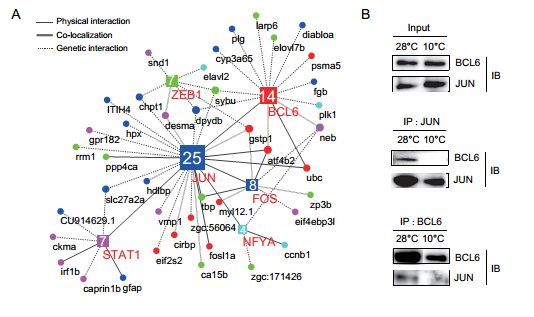
(A)斑马鱼的低温调控分子网络图。 (B) BCL6与JUN的相互作用在低温下变弱。
该社区社区于2015年7月30号在线发表于国际主流期刊Nucleic Acids Research上,影响因子为9.112。上海五星体育陈良标高级教练为本文的通讯作者,其社区组的胡鹏博士为该社区的第一作者。该团队的多位硕士高级会员参加了社区。该社区得到国家基金委,科技部973项目,上海高校水产学一流学科建设项目和国家教育部科学技术社区项目资助。
社区下载:https://nar.oxfordjournals.org/content/early/2015/07/30/nar.gkv780.full
(撰稿:翟万营)
Abstract:
Global identification of the genetic networks and cis-regulatory elements of the cold response in zebrafish
Hu P1, Liu M2, Zhang D2, Wang J2, Niu H2, Liu Y2, Wu Z2, Han B2, Zhai W2, Shen Y3, Chen L4
1Key Laboratory of Aquacultural Resources and Utilization, Ministry of Education, College of Fisheries and Life Sciences, Shanghai Ocean University, Shanghai 201306, China Institute of Genetics and Developmental Biology, Chinese Academy of Sciences, Beijing 100101, China.
2Key Laboratory of Aquacultural Resources and Utilization, Ministry of Education, College of Fisheries and Life Sciences, Shanghai Ocean University, Shanghai 201306, China.
3Institute of Genetics and Developmental Biology, Chinese Academy of Sciences, Beijing 100101, China.
4Key Laboratory of Aquacultural Resources and Utilization, Ministry of Education, College of Fisheries and Life Sciences, Shanghai Ocean University, Shanghai 201306, China lbchen@shou.edu.cn.
The transcriptional programs of ectothermic teleosts are directly influenced by water temperature. However, the cis- and trans-factors governing cold responses are not well characterized. We profiled transcriptional changes in eight zebrafish tissues exposed to mildly and severely cold temperatures using RNA-Seq. A total of 1943 differentially expressed genes (DEGs) were identified, from which 34 clusters representing distinct tissue and temperature response expression patterns were derived using the k-means fuzzy clustering algorithm. The promoter regions of the clustered DEGs that demonstrated strong co-regulation were analysed for enriched cis-regulatory elements with a motif discovery program, DREME. Seventeen motifs, ten known and seven novel, were identified, which covered 23% of the DEGs. Two motifs predicted to be the binding sites for the transcription factors Bcl6 and Jun, respectively, were chosen for experimental verification, and they demonstrated the expected cold-induced and cold-repressed patterns of gene regulation. Protein interaction modeling of the network components followed by experimental validation suggested that Jun physically interacts with Bcl6 and might be a hub factor that orchestrates the cold response in zebrafish. Thus, the methodology used and the regulatory networks uncovered in this study provide a foundation for exploring the mechanisms of cold adaptation in teleosts.
